
That's a big change that was made possible due to corporate tax cuts. Corporation tax collection in FY22 will be lower than even the FY18 levels, reports
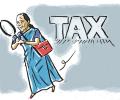
'The economy has to become the government's No. 1 priority, which it is not at the moment,' says T N Ninan.

'It may be prudent not to plunge into a new online tax appeals system in one go, which could only create more disputes and increase the embarrassingly high tax arrears of the government,' warns A K Bhattacharya.

Finance Minister Nirmala Sitharaman on Wednesday said the Union Budget strikes a fine balance between growth, employment, and fiscal consolidation, and promotes cooperative federalism. Replying to the discussion on the Union Budget 2024-25 and Union Territory of Jammu and Kashmir Budget in Rajya Sabha, the minister said the government is on track to achieve the pre-announced fiscal deficit target of 4.5 per cent by 2025-26. Sitharaman, also a former defence minister, said the Agniveer Scheme to recruit people in the age group of 17.5 to 21 years, is aimed at keeping the armed forces fit, young and battle-ready.

For every rupee in the government coffer, 58 paise will come from direct and indirect taxes, 34 paise from borrowings and other liabilities, six paise from non-tax revenue like disinvestment and two paise from non-debt capital receipts, according to the Budget documents for 2023-24.

Union Finance Minister Nirmala Sitharaman, along with her team of bureaucrats, delved into the fine print of the 2024-25 Budget documents in a press conference, detailing the government's road map on bringing down the debt-to-GDP ratio and bold tax measures.

Finance Minister Pranab Mukherjee might have to fall back on divestment and other non-tax revenue sources while presenting the Budget for 2009-10 on July 6, economists believe.

The deficit stood over Rs 8 trillion in the first seven months of the current financial year. Non-tax revenues, comprising transfers from the RBI and dividends of the public sector units, shored up the Centre's revenues.

Clearly, the extra borrowing of Rs 4.2 trillion the government has planned so far will not be enough to meet the shortfall in revenues which could be between Rs 8 trillion and Rs 10 trillion, points out A K Bhattacharya.

The finance minister's assertion that industry should not expect any spectacular announcements in the 2024 interim Budget suggest that the electoral imperatives of more tax concessions or higher expenditure on welfarist programmes could be far less pronounced than they were before the 2019 interim Budget, expects A K Bhattacharya.

The thinking at the Centre is that since the RBI has ramped up purchases of government bonds, the interest earned on them will be transferred to the exchequer as dividend.

The dividends for the economy from such a rapid rise in capital expenditure would be huge, observes A K Bhattacharya.
The fiscal deficit rose primarily on the back of lower non-tax revenues, which came in at 60 per cent of full-year target, compared with 62.4 per cent for the same period last year.

The government had budgeted revenue realisation for 2012-13 fiscal at Rs 10.38 lakh crore (Rs 10.38 trillion).

The Union government's finances witnessed significant improvement in August after a stressful first four months of the current fiscal year. India's gross tax revenue, comprising both direct and indirect taxes, for the first five months of 2023-24 surged 16.5 per cent year-on-year (Y-o-Y) to Rs 11.8 trillion. During the April-July period, gross tax revenue increased by a mere 2.8 per cent compared to the Budget Estimate of 12.1 per cent growth for FY24.

The interim Budget proposals that will be presented on February 1 in the backdrop of the general elections scheduled in April/May 2024 are likely to have a hint of populism, believe analysts, but are unlikely to derail the government from its path of fiscal prudence.
For every rupee in the government coffer, 58 paise will come from direct and indirect taxes, 35 paise from borrowings and other liabilities, 5 paise from non-tax revenue like disinvestment and 2 paise from non-debt capital receipts, according to the Budget documents for 2022-23. According to the Union Budget 2022-23 presented in Parliament by Finance Minister Nirmala Sitharaman on Tuesday, goods and services tax will contribute 16 paise in every rupee revenue, while corporation tax will contribute 15 paise to each rupee earned. The government is also looking to earn 7 paise for every rupee from Union excise duty and 5 paise from customs duty. Income tax will yield 15 paise to every rupee collection.
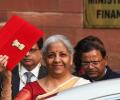
'... that it once again shies away from renewing its commitment to strategic divestment,' points out A K Bhattacharya.

The fiscal deficit, gap between expenditure and revenue.

GDP growth of 7.7 per cent in the first half of this fiscal has "left sceptics gasping and woefully behind the curve", an RBI article said on Wednesday. It also stressed the buildup in the growth momentum is likely to be sustained. The article on the state of the economy published in the Reserve Bank's December Bulletin on Wednesday also said CPI-based retail inflation is expected to ease to 4.6 per cent in the first three quarters of 2024-25 from 5.6 per cent in November.

The Indian stock markets may turn bearish after the US Fed decides to raise interest rates.

The government is also looking to earn 8 paise for every rupee from Union excise duty and 3 paise from customs duty. While, income tax will yield 14 paise to every rupee collection.

Strategic sales are tricky and were last undertaken when the Vajpayee government was in power.

The government is set to earn an equity dividend of nearly Rs 13,800 crore from the listed public-sector banks (PSBs), all 12 of them, for FY23, up 50 per cent from Rs 9,210 crore in FY22. This will be the highest ever dividend for the government from PSBs. The 12 PSBs in our sample are paying an equity dividend of nearly Rs 21,000 crore for FY23, up 53 per cent from Rs 13,710 crore for FY22.
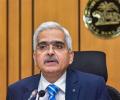
The RBI raked in a massive net income gain from foreign exchange currency sales as a buffer for the rupee during tumultuous geopolitical upheavals last year owing to Russia's invasion of Ukraine.
Disputes or otherwise, the government is yet to receive over Rs 1 trillion in taxes from corporates and other entities and add to it other arrears worth about Rs 47,000 crore (Rs 470 billion), the total outstanding equals more than half of the total revenue deficit this year.

Large states like Andhra, Chhattisgarh, Gujarat, Himachal, MP, Odisha, Punjab and Tamil Nadu would need compensation from the Centre

Finance Minister Pranab Mukherjee had said additional money from 3G spectrum auction will provide him a little elbow room to manage the government finances.
Revenues from 3G and Broadband Wireless Access spectrum auction has helped government reduce the deficit.

For every Re in govt coffer, one-fourth will come from market borrowing.

The Centre could further moderate its divestment target for 2024-25 (FY25), as it does not expect large receipts from asset sales - except some ongoing strategic ones, including IDBI Bank, which could spill over into next financial year. Also, it may drastically reduce its FY24 divestment target of Rs 51,000 crore. "We are still evaluating the Budget estimates for FY25. "New big-ticket asset sales are unlikely.

Alloting more funds for MNREGA and PM-KISAN could wipe out the entire additional money that the Centre may have for FY25.

Finance Minister Nirmala Sitharaman on Monday said the government has come out with open and transparent Budget and has not made any attempt to hide anything under the carpet.

The Comptroller and Auditor General can do a performance audit of production sharing contracts

Maharashtra is the BRS' first target.

On the basis of Budget projections, the Centre needs Rs 7.3 trillion revenue during December-March and its expenditure must be limited to Rs 6.7 trillion.
